 I could easily become a plant-talking, tree-hugger. I grew up in a small farming community and spent my summers in high school and college caring for my neighbor’s vineyards and orchards. I love to visit gardens and work with plants. I dream of owning a plant nursery someday. But I also enjoy helping individuals listen for God’s voice and bond more closely with Father, Son, and Spirit.
I have noticed that in the Bible, plants such as trees, bushes, vines, grasses, or wheat are frequently used to illustrate some truth about human beings and our relationship with God. Plants like humans germinate, sprout, grow, develop, bear fruit, have root systems, benefit the world in a variety of ways, become diseased, and die.
It is also intriguing to observe the interaction between plants and Biblical characters—Adam and Eve and the trees of knowledge and life; Moses and the burning bush; Elijah and the broom tree; Jonah and the unpredictable plant; Jesus and the vine; the disciples and the fig tree.
I have been reflecting upon the passage from Jeremiah 17:7-8.
Blessed is the man who trusts in the Lord, whose confidence is in him. He will be like a tree planted by the water that sends out its roots by the stream. It has no worries in the year of drought and never fails to bear fruit.
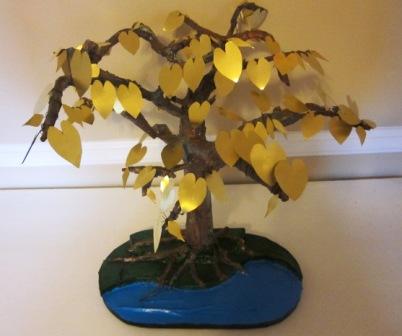
I decided to create a papier-mâché sculpture of the verse which is shown in the photo above. The photos below show the process I used to create the finished piece.
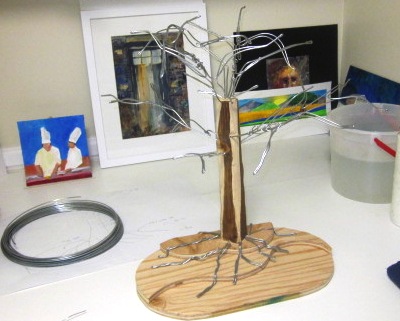 Step One-I cut a base from plywood, bolted a trunk to the base and then formed wire for the branches and roots. Though roots are normally hidden, I wanted to expose them. In the verse, roots are what connect to the water. In an earlier verse in Jeremiah, God is said to be like a fountain head of refreshing water and the roots are what connect to the eternal source of life.
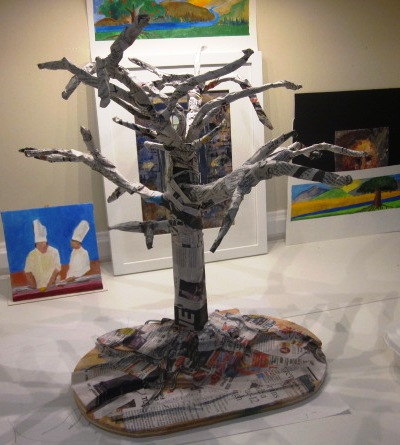
Step Two- I then cut strips of newspaper and glued that onto the wire and trunk and let it dry.
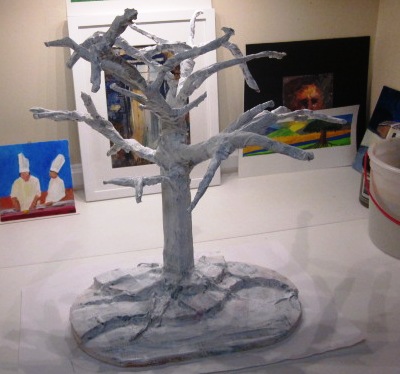
Step Three– I then painted the entire piece with white gesso, which sealed the papier-mache and covered up all the holes.
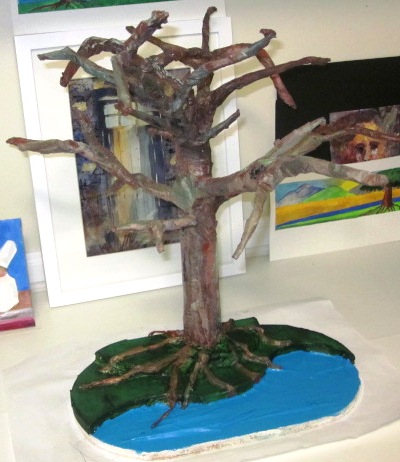
Step Four– I then used acrylic paint to paint the base, roots, trunk, and limbs. I wanted the tree trunk to reflect a sense of age, weathered wisdom, and stability. Afterwards I added the leaves cut from thin brass sheet. My initial idea was to make the leave look like grape leaves and tie this passage to the one in John 15. (I am the vine and you are the branches.) But grape leaves proved too complicated to cut. They ended up looking like hearts, which I thought was a good accident. In the Book of Revelation the leaves from the tree of life were to be used for the healing of nations. They also shine like the leaves of the burning bush in the book of Exodus. I like the illusions. I later added fruit taken from an old Christmas decoration.
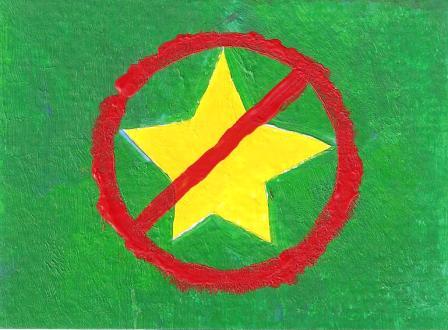 “Oh my anguish my anguish! I writhe in pain. Oh the agony of my heart! My heart pounds within me, I cannot keep silent. For I have heard the sound of the trumpet; I have heard the battle cry. Disaster follows disaster, the whole land lies in ruins. Jeremiah 4:19-20
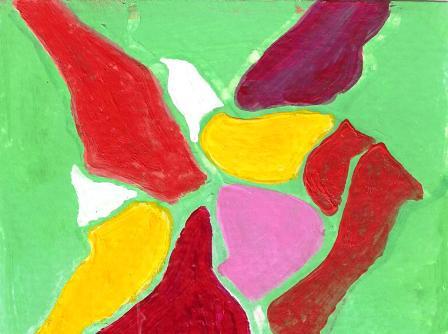 “How gladly I would treat you like sons and give you a desirable land, the most beautiful inheritance of any nation. I thought you would call me ‘Father’ and not turn away from following me. But like a woman unfaithful to her husband, so you have been unfaithful to me, O House of Israel,” declares the Lord. Jeremiah 3:19-20
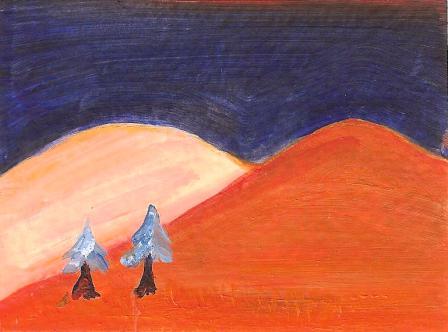 They did not ask, “Where is the Lord who brought us up out of Egypt and led us through a land of deserts and rifts, a land of drought and darkness, a land where on one travels and no one lives.” Jeremiah 2:6
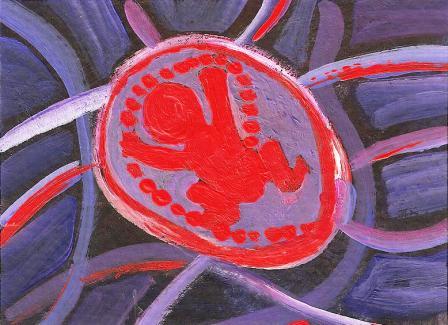 Before I shaped you in the womb, I knew all about you. Before you saw the light of day, I had holy plans for you: prophet to the nations—that’s what I had in mind for you. Jeremiah 1:3
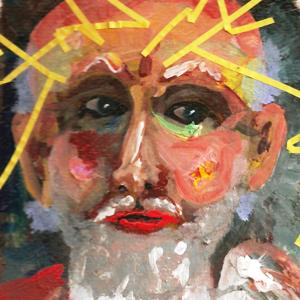 Talk about a tough job assignment. In 627 BC the Assyrian Empire, wracked by internal strife, was crumbling. Babylon to the north was rising, Egypt to the west was threatening, and tiny Israel was caught in the middle. Having abandoned their original purpose as a nation under God, worship of Yahweh was a shell. The nation, torn by its own civil strife into two kingdoms of Israel and Judah, had given itself as a prostitute to other foreign gods. Into that maelstrom of political plots and religious apostasy, Jeremiah was called to speak. But few would listen. In the end his warnings proved to be true and the nation was destroyed and carted off into captivity.